Auna AV2-CD608BT 4-Channel HiFi Amplifier - Technicalities
This domestic audio amplifier boasts, unusually, four channels - more conventionally considered as two, identical stereo pairs.&npsp Input is selectable from one of five, stereo sources.
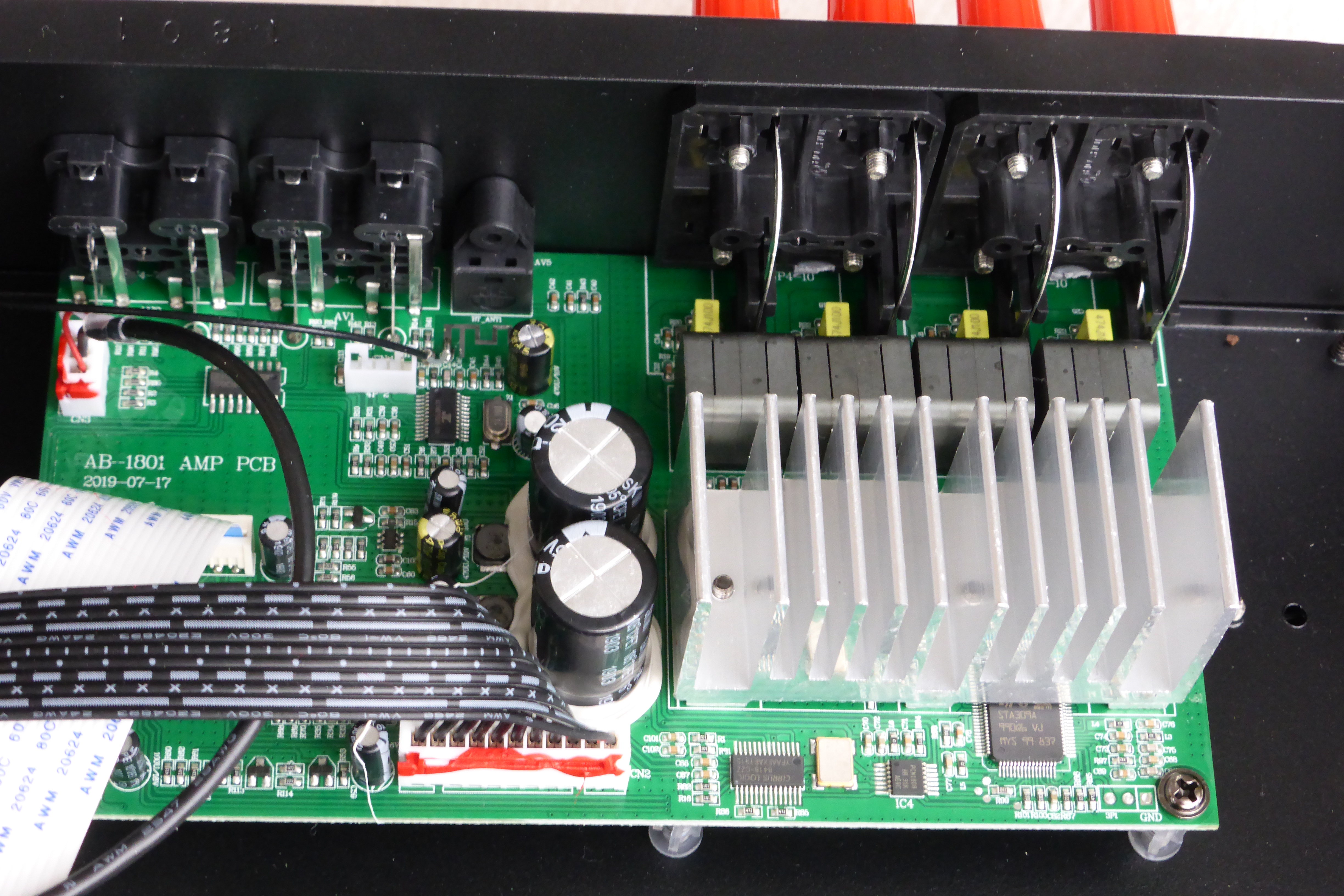
The heart of the unit is a STMicrocircuits STA309A digital audio processor (partly occluded, in the photograph below, by the heat sink for the output devices). Perusing its data sheet suggests this is a highly capable and configurable (by the system implementor) device intended to support the implementation of 5.1 surround sound systems. It offers eight, independent audio channels, but for this application, just four are used - configured as two identical channels plus a further two identical channels.
The circuitry, mostly surface-mounted - except for the power supply - is implemented on five boards – the main two being: the bulk of the audio processing - including the output switch devices… and the switch-mode power supply. The power supply provides 3.3V and 5V for the digital circuitry and four, individual, 30V supplies for the output devices (sandwiched between the heat sink and the PCB - so not identifiable).
Analogue to digital (A/D) conversion is achieved by a Texas Instruments PCM 1808.
Output switches - hidden.
I presume that the Cirrus Logic CS 8416-CZZ CODEC chip handles the optical input (tested, OK).
An STMicroelectronics HCF 4052 multipexer provides input selection.
Bluetooth Tx/Rx - dunno - possibly the chip with an "AS19AP1xx" designation.
I-R receiver/decoder? (not tested) - I'm unable to identify the culprit.
Allowing for practical considerations, the maximum audio output into an 8Ω load is c. 57 Volts p-p i.e. c. 50 Watts RMS [57V2/(8 x 8Ω)]. A label on the back-panel cautions that the load should be no less than 8Ω per channel - the handbook states "equal or more than 6Ω" *. So, although a maximium 100W RMS into 4Ω may theoretically be possible from a single channel, practically it wouldn’t be available (especially from all channels simultaneously). Over-drive protection intrudes perceptibly on content as theoretical maximum output is approached. The Class D output topology employed is ‘Bridge-Tied Load’ (BTL) - this precludes the possibility of simply ‘bridging’ outputs – say, to increase the power into 16Ω loads (to >25W RMS).
The unit’s audio frequency response should, as my pair of Q Acoustics 1050 loudspeakers (floor-standing, reflex, two 6.5" drivers plus tweeter) confirm, be exemplary (source material: MPEG-3 at >190kbps) - particularly low frequency extension (needed for 5.1’s full bandwidth channels and the Low-Frequency Effects [LFE] channel) which delivers deep bass (in an 'indoor' location - tone controls set at neutral). Audio noise + distortion for competently designed, integrated Class D amplifiers is typically less than 0.1% - so not a material issue in most applications.
Tone controls operated smoothly and effectively, giving - I would estimate - over 10db of boost and cut. Bluetooth streaming ‘paired’ and connected reliably to my Android phone and tablets within a cupla seconds. An LED indicates when pairing has been achieved - but not to which device). I did notice that the RCA inputs are rather less sensitive than the 3.5mm jack ("MP3"). I also observed one minor artifact: the very slight background hiss, apparent at extremely low output levels, varied intermittently in volume every few seconds.
I purchased the unit for about £80 from  via Amazon shortly after it was introduced into the UK in late 2019, which I considered pretty good value. I’d probably not spend more than £110 on it (in 2021), unless I particularly needed a duplicated (carrying identical content), pair of 50W channels - perhaps for a two-area application where volumes wouldn't need to be independently controlled - say, in a bar or parish hall complex. Or, if stereo reproduction isn't a requirement, one could, for a multi-speaker environment, say a retail outlet, have four, identical channels - and using the balance control, alter the volume, slightly, of two channels relative to the other two (as a budget alternative to a 100V-line distributed system).
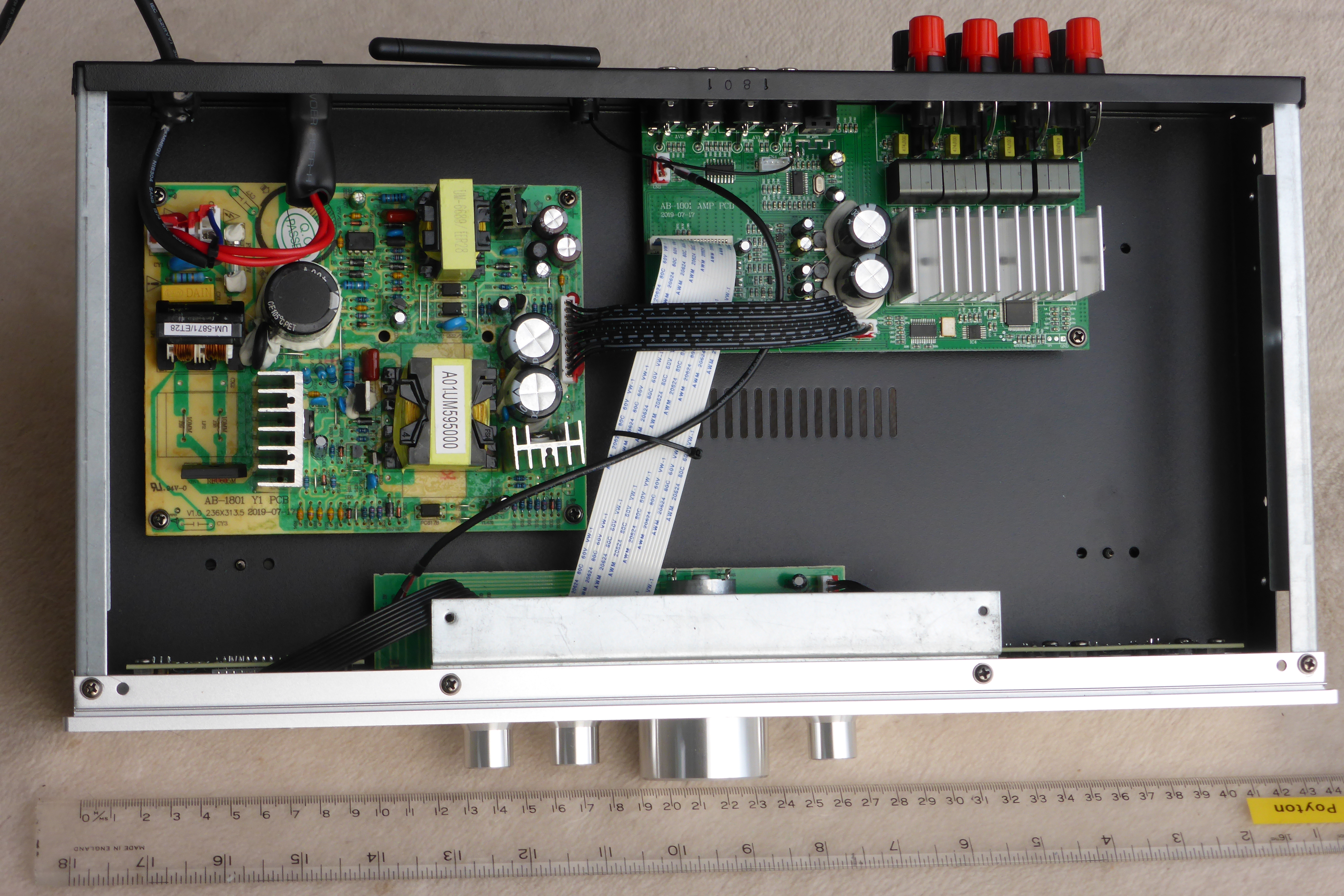
The ‘internals’ - devoid of any 2N3055s! (or EL34s)
On the left: the power supply board, the main amplifier board is on the right. An orientable, Bluetooth antenna is mounted on the back panel. An audio lead snakes its way from a 3.5mm jack socket on the front panel to audio input circuitry at the top left of the amplifier board.
 |
Main amplification board.
Four stereo inputs (RCA) top left, the optical input (there’s no USB type-C port), four output channels (two stereo-pairs) top right with output filtering (apparently four ‘L’s per channel - so 16 ‘L’s in total) below. The extruded aluminium heatsink looks transparent, but it's just surface reflections.
 |
Worth considering
UK homes built within the last 120 years, normally have a room height of c.2.4m, a dimension which can cause sound to resonate at a fundamental frequency of around 70Hz (for which the wavelength is c.4.8m).
A room may also display two other, dimension-dependent resonances close by. (Ideally, no two dimensions would be within about 10% of each other.) The level of these 'Room mode' resonances - resulting from standing waves - will vary with spatial positioning within the room (most evident at room boundaries). To complicate matters further, the room placement of audio source(s) (loudspeaker) will, due to low frequency reflections, also affect the bass response.
It may be beneficial to modify the low frequency response of audio sources (by adjusting 'EQ') to mitigate the effect of intrusive reflections. I use a free, versatile, function generator application from Keuwlsoft on my tablet/phone to identify resonances. I initially configure a sine wave to sweep, say from 30Hz to 250Hz to identify intrusive peaks as I walk around the room (a more precise indication can be provided by Carl Reinke’s fine Spectroid [audio spectrum analyzer] application or a Sound Pressure Level [SPL] meter app. [but be mindful of the limitations of your platform’s frequency response]). Then tweak the source’s drive level (only by a few dB) for those frequencies using the 10-band equalizer (less flexible than tunable 'notch' filters) in my media player.
One may reasonably conclude that, as long as the elements of an audio system are competently designed for their application, its reproduction performance will depend predominantly on the physical characteristics of the listening environment.
*An 8Ω impedance (measured at 1kHz) loudspeaker will typically present a c.6Ω resistance.
© Col
₠ ⁻ ⅒ ⅕ – ≥ → ⅓ ⅔ ⅕ ⅖ ⅗ ⅘ ⅙ ⅚ ⅛ ⅜